Before we can begin to apply our new-found music knowledge to our guitar playing we need to know our instrument.
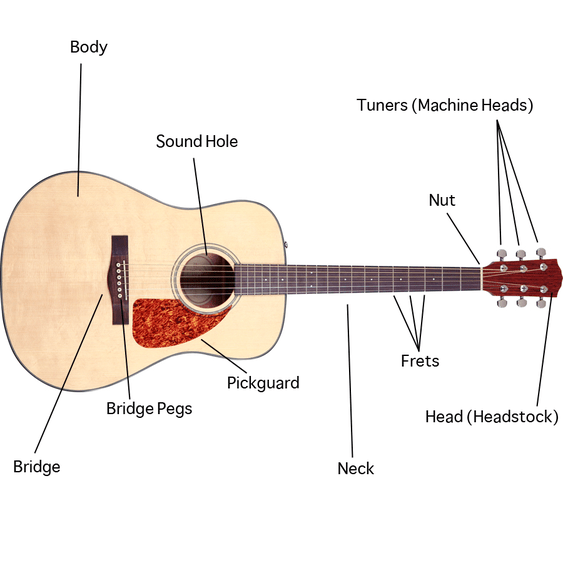
The diagram shows the physical parts of a guitar. Most new guitarist are aware of these so they are here only as a reference.
Additionally, we will refer to the CAPO ( a sliding clamp across the fretboard to increase the key for the same chords) and a tuner to make sure your instrument is sounding as it should.
Open Strings
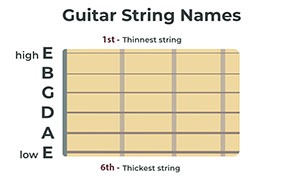
Each guitar string has a name (or note in accordance with it’s pitch/sound). The open strings (without any finger on the fret ) are named E,A,D,G,B and E – as per the diagram.
When we put our finger on a fret it changes the note as per the scale (similar to going up a semitone on a piano. Each fret is a semitone above it’s previous one.
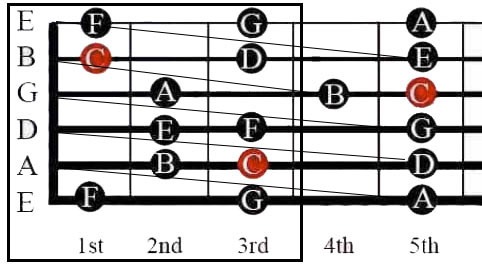
In C scale (all major notes) putting our finger on the first fret of the E string makes an F note (remembering that these is no semitone between E and F or B and C). There is a semitone between F and G and so to make the G note we need to put our finger on the 3rd fret.
Image shows major notes – all being able to be played within the first 3 frets. Also shows how the stings are “tuned” to the relevant string above it.
Notes, Frets and Tuning
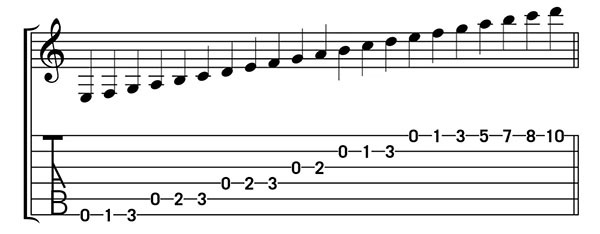
.In theory, we could play any song on one string (as per diagram).
If we just look at the major notes it looks like a piano keyboard .
This is impractical and does not allow for chords. Our fingers restrict us to playing 5 notes on a string – the open and then one note per fret for each of our 4 fingers.
To make the guitar work with just the open and four fingers, we add strings below and TUNE the next string to be the same as the 5th fret on the string above it. So that we don’t have to go to the 4th fret the B string is tuned to the 4th fret above it.
We then end up with the traditional six string fretboard as we know it. It is essential that we learn these strings and notes – to the 3rd fret
Guitar tablature (tab) is a simplified musical notation using six lines (representing guitar strings) with numbers indicating which fret to play, making it easy to learn songs without standard music theory; it’s read left-to-right, with numbers showing finger placement (0 for open string) and stacked numbers for chords,