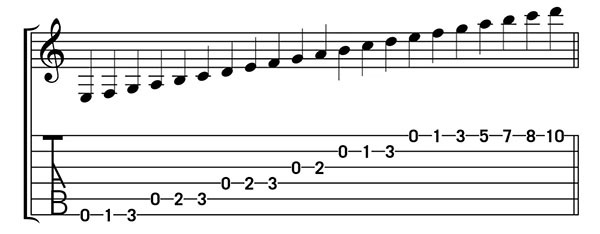
Reading guitar tabs is intuitive as it visually represents the guitar’s fretboard. You read the notation from left to right to determine the sequence of notes or chords.
Lines and Strings: The tab consists of six horizontal lines, each representing a string on the guitar. The top line is the thinnest, high E string, and the bottom line is the thickest, low E string.
Numbers and Frets: Numbers placed on the lines indicate which fret to press on the corresponding string. A “0” means you play the string open (without pressing any fret).
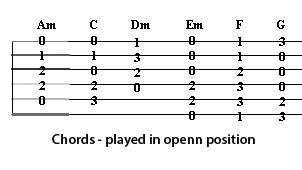
Chords: When numbers are stacked vertically, you play those notes simultaneously as a chord. Chord names are often labeled above the staff for clarity.
Rhythm: Most basic tabs don’t show rhythm clearly, so it is best to listen to the song for timing. Advanced tabs may include standard rhythm notation (stems and flags) alongside the tab lines or use spacing to suggest duration.
Notes - shown as musical notes and in tabs
Understanding Tablature Variations
Our guitar offers a variety of ways to make different sounds and tunes. As well as playing note and chord sequences we can add effects to notes to make the guitar sound as we wish and as we hear in the many famous guitar riffs. the main ones are outlined below.
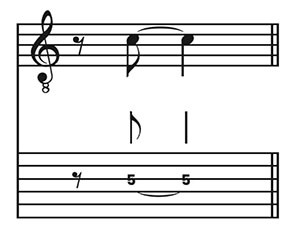
Tie
A tie is when you extend the duration of a note or chord.
In TAB: A curved line connects two notes of the same pitch
How to perform: The first note is struck and held for the length of the second note, but the second note is not struck.
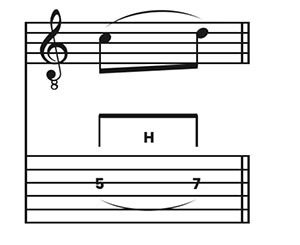
Hammer On
A hammer on is a technique where you slam your finger onto the higher fret
In TAB: A curved line (slur) connects a lower note to a higher note. You may also see the letter H, either replacing or adding to the curved line.
How to perform: Strike the lower note, then hammer your finger onto the fretboard to produce the note, without picking the string.
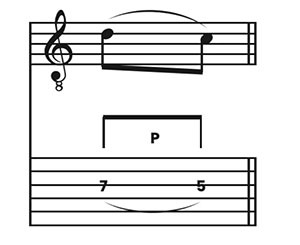
Pull Off
A pull off is pulling a finger off a string, so that the lower note sounds with being plucked
In TAB: A curved line (slur) connects a higher note to a lower note. You may also see the letter P, either replacing or adding to the curved line.
How to perform: Strike the higher note, then flick off the finger to produce the lower note. Usually dragging the finger downwards across the string will produce the best result
Slide
A slide is a technique where a note slides from a lower pitch to a higher pitch, or vice versa.
In TAB: The note you’re sliding from is connected to the note you are sliding to, by a diagonal line and a curved line (slur) and/or the symbol ‘sl.’
How to perform: The first note is struck, then, without releasing pressure on the fingerboard, the finger slides up or down to the next note.
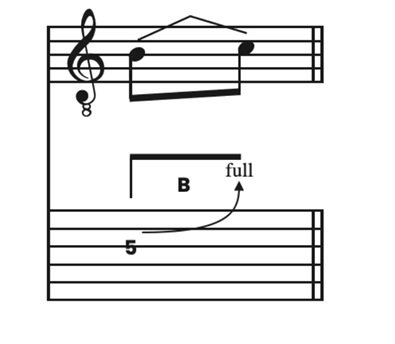
Bend
Bending strings is a personal technique with a ton of possible variation. The way you bend strings really forms a large part of your playing style and personality.
In TAB: The symbol for a bend is a curved upward arrow, which can also be coupled with or replaced by the letter B.
The word Full indicates a tone bend, the equivalent of two frets. ½ signifies a semitone bend, the same as one fret. ¼ indicates a slight bend.
How to perform:
Play the first note shown in TAB, then push/pull the string upward/downward to raise the pitch the amount specified.
As a general rule the Low E, A, and D strings are (for right-handed guitarists) bent downward towards the floor, whereas the higher strings, G, B, and e are bent upward.
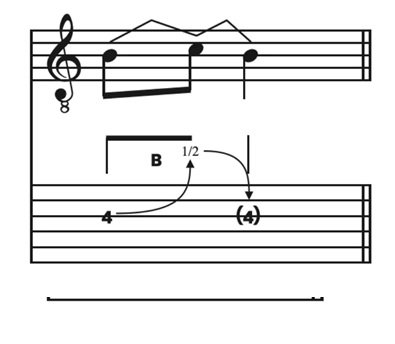
Bend & Release
Bending and releasing a note allows you to bend the note up to a higher one, then return it back down, usually to the note you started from.
In TAB: This is indicated by a bend followed by an arrow curving downwards
How to perform: Once you have bent the note upward, you keep pressure on the string and release the tension, (normally) returning to the note you started from
Mute
A muted note occurs when the finger rests on the fret, but no pressure is exerted to make that fretted note sound. The result is a percussive sound with an indistinct pitch. Sometimes if a single finger is resting on a harmonic, that harmonic pitch will sound, in which case more than one finger needs to be applied, to avoid the harmonic note sounding.
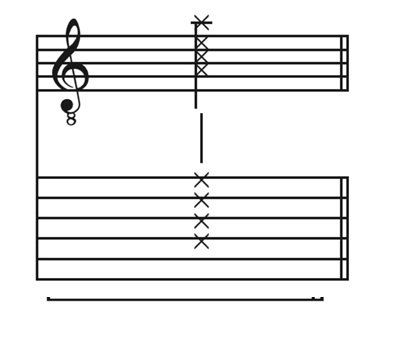
In TAB: Instead of a fret number, an X is used in its place
How to perform: Mute the string marked with an X with a finger or group of fingers, and pick the string the same as playing a normal fretted note.